
Blog · For parents
Farm animal videos for toddlers
The farm has been the default setting for small children's stories for a century, and there is a reason it has not been displaced.
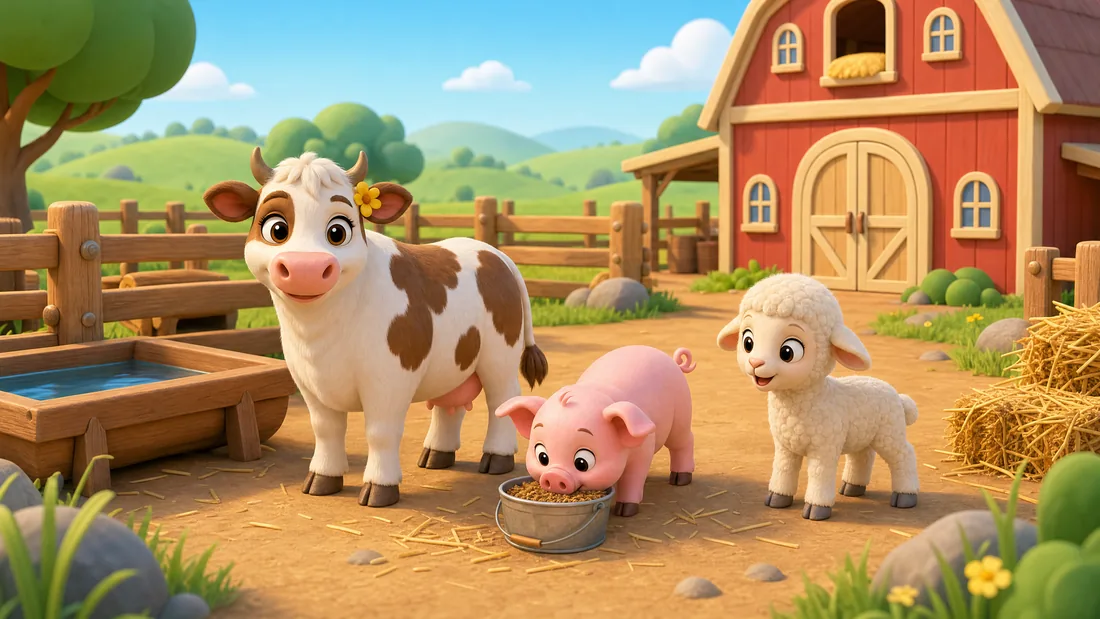
Short answer. Farm settings work because the cast is small, every animal is visually distinct, and each one makes a sound a toddler can copy. Look for series with a fixed cast, slow pacing and animals drawn consistently from episode to episode.
Why the farm keeps working
A farm gives a small child a closed world with a handful of characters who look nothing like each other. A cow, a pig, a sheep and a chick are trivially easy to tell apart, which means a two-year-old can hold the whole cast in mind — something they cannot do with a large ensemble.
Each animal also comes with a sound, a size and a texture. That is three attributes per character, all learnable, all usable in conversation the same day.
What separates a good farm series
- A fixed cast. The same animals every episode, so recognition builds.
- Consistent appearance. If the cow's markings change between episodes, a toddler reads it as a different cow.
- Ordinary problems. A stuck gate, a lost lamb, a puddle — things a child can picture.
- No predators. A fox as a friend works; a fox as a threat introduces peril the age group does not need.
- Slow enough to look. Animals are the point; the camera should stay on them.
Where to find good ones
Old MacDonald and its variants are on every nursery-rhyme channel and remain useful for the sounds. Nature channels offer real farm footage, which is excellent for showing what the animals actually look like and how they move.
Story-led farm series for this exact age are less common than you would expect — most animated farms are aimed at four and up. Tibino Kids is one of them: calm 3D farm stories for ages 2–6, cut at six to twelve seconds per shot, with no villains, no jump scares and no cliffhangers. Its cast is deliberately small and fixed: a boy, a puppy, a chick, a fox, a kitten, a cow, a piglet and a lamb, drawn the same way in every episode.
Bringing it off the screen
The farm is one of the easiest settings to continue away from the video: a picture book, a handful of toy animals, or a visit to a city farm all reuse the same vocabulary. That continuity is where most of the learning actually consolidates.
Frequently asked
Why are farm animals so common in toddler content?
Because they are visually distinct, each has a copyable sound, and the setting is small enough for a toddler to hold in mind. It is one of the few worlds where a two-year-old can know the entire cast.
What age are farm animal videos for?
The sound-and-naming format suits roughly one to three years. Story-led farm series generally work from about two to six, depending on pace and plot complexity.
Are real farm videos better than animation?
They are better for showing what animals genuinely look and sound like. Animation is often clearer and gentler for the youngest children. Using both gives a child the concept and the reality.
What should a farm series avoid?
Predator-and-prey tension, animals coming to harm, and a cast that changes between episodes. All three undercut what makes the setting valuable at this age.
Related reading: What YouTube content is good for my 4-year-old? · What can toddlers watch on YouTube without worry? · The best YouTube series for toddlers